Monday, March 7, 2011

Rudy Filion - "Ol' Smoother" - Philadelphia Ramblers, Jersey Devils

Over the last few weeks I have been in touch with a member of the Rudy Filion extended family. Rudy was in hospice care. They were on a "jersey quest" to find one of Rudy's jerseys. Probably like a lot of players of that era, he never kept any.

I spent about three days last year trying to track down an EHL photo of Rudy, and it's hard to do that without getting a little attached to the person you're researching. Rudy has one of the best Points Per Game averages in EHL history. First of all he had 55 points in 27 games after arriving for the Ramblers in 1963-64. That's over 2 points a game! The Ramblers moved across the river to Jersey the next season. Rudy played two more seasons with the Devils, before hanging up the skates. He finished with 223 points in 153 EHL games.

Before coming to the EHL, Rudy was a major force in Seattle hockey for 15 years, scoring 869 points in 887 games, second most behind the famed Guyle Fielder. Rudy is a member of the Seattle Hockey Hall Of Fame. SeattleHockey.net has a good PDF page on Rudy's career. It sounds as if he was pretty beloved. You can read about and see more pictures of Rudy in Jeff Obermeyer's book "Hockey in Seattle".

Back to the jerseys, Rudy wore number 9 during his two EHL seasons with the Jersey Devils. We don't know what number he wore with the Philadelphia Ramblers, yet. It wasn't #9, which was Art Hart. It also wasn't #6, which he preferred in Seattle, that was Wayne Caufield. If you happen to have a Filion jersey, let me know, and I can put you in touch with the Filion family. The good news is that they did find a jersey - Rudy's #6 from the Seattle Totems. Rudy had given it to his son, and it was just found, 30 years later.

The photo up top is from a Devils 1965-66 game program. The photo to the left is from the 1963-64 Philadelphia Ramblers Team Photo. Almost every shot I've seen of Rudy, he appears smiling and happy.

Here's Rudy's obituary and Guest Book from the Seattle Times:
Rudy FILION Age 83, born April 3, 1927 in Cornwall, Ontario, Canada, died Feb. 25, 2011 following a long, courageous battle with cancer. A very bright student, Rudy graduated from high school early, and at the age of 16 joined the Royal Canadian Air Force. After a year of service he left home to begin his hockey career with the Tacoma Rockets. There he met and married the love of his life, his wife of 63 years, Ethel Gunnette.

Over the next 14 years he played for the Seattle Ironmen, Bombers, Americans and finished his playing career with the Seattle Totems. He then went on to scouting and retired from the NHL. During his career, he became known for his incredible sportsmanship, class and tenacity. He was honored on numerous occasions including a 'Rudy Filion Night' where he was recognized by his teammates, fans and the city. He was also a nominee for Man of the Year by the Seattle P.I

He was preceded in death by his wife Ethel. Survived by his son Ron Filion (Cheri), daughters Diane Mitchell and Cindy Burger (JP), 7 grandchildren and 1 great-grand child. Private burial will be held Fri. March 11. Friends of family are invited to attend a celebration of his life on March 12. For Celebration of Life info or to share a memory, please contact: www.becksfuneralhome.com

Monday, February 21, 2011

Proof: Evel Knievel Tried Out With The Charlotte Clippers

Like most of the Eastern hockey League stuff I find, I was looking for something else when I came across the note below in the October 11, 1959 Montana Standard by Frank Quinn.

There are lots of places on the web that mention Evel Kneivel , or "Bob" as he was then known, played for the Charlotte Clippers. But like so many things on the web, it's all from hearsay with no definitive proof. Well, here's step one of the proof.


Here's the October 18, 1959 follow-up by Frank Quinn of the Montana Standard.
So, the world's greatest stunt driver ever, Evel Knievel's Eastern Hockey League career ended because he didn't like to ride the bus. ***Pauses to hold back a giggle at the irony.*** It reminds me of one time when my mom and I were Christmas shopping in Haddonfield, NJ (about a mile from Cherry Hill Arena ***lame EHL connection to justify story***). As the stores were closing and we headed to our cars, Santa Claus came over and confided to my mom and I that the parking lot really should be better lit. In other words, Santa was afraid of the dark. Mom still howls when she remembers that.

Bob Knievel was very influential in developing hockey in Butte, Montana in the late 50s. He coached, managed and played for the Butte Bombers of the American Hockey Association that season. after returning from Charlotte. Could you imagine him and a young John Brophy on the Clippers defensive line? Hmmm, I always thought I'd write a nice dry history of the Eastern Hockey League (once I get http://TheEHL.com more-or-less finished), but maybe I need to write a Slapshot prequel with John Brophy and Evel Knievel, complete with a fear of riding buses, on defense. As my friend Murph says, "Could be hideous."

Monday, January 24, 2011

Why EHL Fans Are Better Than IHL Fans

While trolling the web for obscure EHL player pictures, I came across this program with a photo of the 1959-60 Saint Paul Saints. The ad at the bottom answers the question: "Why are Eastern Hockey League fans better than International Hockey League fans?"

Ted Lanyon, John Bailey, Bryan Derrett, Bob Cowan, Hugh Scobie, Lou Crowdis, Joe Woitowich from this team all played in the EHL at one point or another. http://hockeydb.com also includes Don Hart from these Saints as having played for the 1964-65 Jersey Devils, but I'm pretty sure that was actually Art Hart, not Don, on the Devils according to newspaper accounts - though its possible they both could have been on the team.

Tuesday, January 11, 2011

35 Years ago Today - ex-EHLers Help Flyers Defeat Russian Red Army 4-1

Okay, it's a lame pretense for an EHL blog, but it was one of the greatest hockey events ever. 35 years ago today, the Philadelphia Flyers dominated the Russian Red Army team 4-1. The Flyers had ex-Salem Rebel Dave Schultz and ex-Jersey Devils Jack McIlhargey and Bobby Taylor on their squad. I'll let the articles and memories speak for themselves...

From Today's Philadelphia Inquirer:
http://www.philly.com/philly/sports/flyers/20110111_THEGOOD_OL__DAZE.html
35 years ago today, Broad Street Bullies ran Soviet Red Army out of the Spectrum

PLAYING IT BACK, like a train wreck in slow motion, Ed Van Impe can vividly remember the hit that made the Soviets fold like a tent.

The date: 35 years ago today, at the Spectrum, with the two-time defending Stanley Cup champion Flyers facing the Red Army team in the final game of the 1976 exhibition Super Series.

Van Impe darted from the penalty box, about midway through the first period, and watched the Soviets' breakout develop as he got a glimpse of his favorite kind of pass.

"It was a sucker pass,'' Van Impe, 70, said yesterday from his home in Vancouver. "I could see the play developing. The winger made a sucker pass and [Valeri] Kharlamov had to turn his head to get it. I remember watching it, almost in slow motion. And the same time the puck connected with Kharlamov, I connected with him and flattened him.

"I just wanted to welcome him to Philadelphia.'' Read More

From Flyers.NHL.com:
http://flyers.nhl.com/club/news.htm?id=435985
Great Moments: Flyers Conquer the Red Army
By Bill Meltzer - philadelphiaflyers.com
Hockey’s version of the Cold War reached a pinnacle in the 1970s. Team Canada’s narrow victory at the legendary Summit Series in 1972 only heightened the animosity and that had been between brewing between the powers-that-be in North American and Soviet hockey.
...
There was a lot at stake entering the final game. The Flyers were not only defending their status as the NHL’s preeminent team, they also found themselves in the unaccustomed position of representing North American hockey in general and the NHL in particular. Philly was the NHL’s last and best hope for defeating the Red Army.

On the other hand, if CSKA could complete an undefeated gauntlet of games with a win over the Flyers on Spectrum ice (where Philly won a staggering 36 of 40 games in 1975-76, with two ties), the Red Army could rightfully claim to be the best team in any league in the world.

“They didn’t like us and we didn’t like them. So we were ready for a war,” said Flyers Hall of Fame left winger Bill Barber... Read Whole Article

Check out the photos from this article. There's a great shot of Bobby Clarke and Dave Schultz crashing Tretiak in the Soviet nets.

and a little video...

Wednesday, December 15, 2010

Grand Prairie Legends : Galen Head, Johnstown Jets

The Grand Prairie Storm of the AJHL have honored Grand Prairie native and Johnstown Jets' star Galen Head on their website as a Grand Prairie Legend.

LEGENDS: PLAYER GALEN HEAD

Although Galen Head’s hockey adventures took place in six different cities in North America, the most interesting and extensive chapters of his hockey history took place in two cities, Grande Prairie, Alberta and Johnstown, Pennsylvania.

When Galen was six, the Grande Prairie Memorial Arena was familiar turf. His Dad was manager of the arena and Galen all but lived there. The arena was the context for epic battles between the Grande Prairie Athletics and rivals such as the Hythe Mustangs and the Ft. St. John Flyers. However at age six it was not the battles on the ice that captured Galen’s imagination, it was the rink rats. As soon as he was strong enough to push a scraper, he joined the prestigious Grande Prairie Memorial Arena rink rat fraternity. It was in the atmosphere of the Memorial Arena in Grande Prairie where Galen developed his basic skating and hockey skills but it was not organized hockey.

There is only so much hockey one can learn without organized competition. Like sand paper that is needed to polish a surface or a grindstone to sharpen a knife – the rough edges of competition polish and sharpen one’s skills. Galen’s competitive spirit motivated him to move beyond the comfort of the Memorial Arena into the world of minor hockey and the outdoor twin rinks of the Bear Creek Flats where he learned to be part of a team and duel with opponents. Along with his friends and brother Gerald, Galen played through the various levels of minor hockey at the twin rinks until he was sixteen.

In 1986, Galen Head then retired from a professional hockey career and living in Johnstown Pennsylvania was interviewed about his memories of playing minor hockey at the Bear Creek Flats. He recalls a skid shack equipped with a wood burning pot bellied stove that was positioned between the rinks. “We would go into the shack when we came off the ice and the coach would run in saying it was time for a line change and we’d go back onto the ice.” He went on to say, “What I remember the most was the awful cold weather. I remember going out with our helmets on and our toques underneath to keep from freezing. Probably the best days I ever had.” It was in the setting of the twin rinks on the Bear Creek Flats, with its cracked and rippled natural ice that Galen acquired the essential tools of the hockey trade that gave him his professional career.

At age sixteen Galen was recruited to play for the senior Grande Prairie Athletics (the As). Playing with and against mature men in the South Peace Hockey League his playing ability was raised to another level. At the end of his first season, Galen received front-page coverage in the Tribune announcing that he had won Rookie of the Year Honors for the 1963-64 SPHL season. This brought him to the attention of the Edmonton Oil Kings and in the middle of the 1964-65 hockey season Galen played his last game in an A’s jersey and became an Edmonton Oil King. Throughout his tenure with the Kings, he was a complete player and steadily improved. He was with the Oil Kings when they defeated Bobby Orr’s team, the Oshawa Generals to win the Memorial Cup. His performance with the Kings culminated in the 1966-67 season with a remarkable record of 50 goals and 42 assists for a total of 92 points in 56 games 18% of the team’s total goals.

Galen’s success with the Oil Kings equipped him with the confidence he needed to pursue a career in hockey. Galen’s bid for a professional hockey career in 1967 landed him in Pennsylvania where he joined the Johnstown Jets and Johnstown quickly embraced him as one of their own. In the midst of his first season with the Jets he scored 53 goals and earned 105 points in 70 games. Based on his rookie season performance as a Jet Detroit called him up to play in a game against Toronto. The following season he was assigned to play with Detroit’s number one farm team, the Salt Lake City Golden Eagles where a serious early season injury likely thwarted his aspirations to play in the NHL.

However, there was a good fit between Galen and Johnstown. Like Grande Prairie Johnstown enjoyed “rugged, rough and tumble” hockey and there he met and married Gracie. In the 1976 playoffs during Galen’s last season as a player, the Jets and their opponents, the Buffalo Norsemen, were involved in a legendary pre-game brawl reminiscent of scenes in the movie Slap Shot. It was a decisive fifth game in the playoff series that ended without a shot being fired on goal. The opposition refused to return to the ice after the brawl and forfeited the game. That night the standing room only fans in Johnstown saw a fight but no game and after the fight, two police officers and their canine dogs escorted the Norsemen from the arena.

There is something prophetic about this incident as later that year Universal Studios filmed the movie Slap Shot in Johnstown. Galen was captain of the team that inspired the movie, games were filmed in the Johnstown Memorial Arena and the infamous Hanson brothers were members of the 1976 Jets squad. Galen’s wife, Gracie played Pam, one of the player’s wives, and she reports that she still receives a cheque every time the movie is played on TV.

According to a Johnstown sports historian, “Head’s 308 goals rank third all-time in Johnstown history and his 601 points rank fourth. He also had 293 assists, sixth all-time. For eight seasons and 561 games # 8 was the Johnstown number one ambassador on the ice. Galen Head, the prolific scorer, team leader, gentleman, and all-around good guy, represented the Jets as a star player, team captain, and player coach.”

During his retirement Galen organized a high school hockey program that won several state championship competitions, he was a volunteer coach with the Jets and he and his wife established a hockey scholarship program to commemorate the life of their son who was killed in an automobile accident. In 2003 Galen’s #8 jersey was retired and he was inducted into the Johnstown Hockey Hall of Fame and the Cambria County Sports Hall of Fame. He is recognized in 2010 as a Grande Prairie Hockey Legend.

Where Are They Now? - Danny Sullivan, Goalie, Roanoke Valley Rebels

Netminder Danny Sullivan backstopped the Roanoke Valley Rebels to the EHL Playoff Finals in 1972-73. The photo to the right shows Sullivan with the Philadelphia Fireirds of the NAHL. Here's an article from the December 8, Kimberley (BC) Daily Bulletin on Sullivan's return home.
Dan Sully Sullivan returns to Kimberley

Carolyn Grant photo
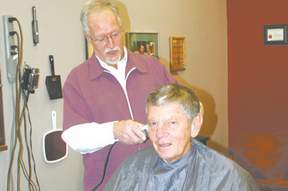
Dan Sullivan gives Bob Misuraca a trim.

There is a new barber in Kimberley. Actually, Dan Sullivan, who recently opened his barber shop next to the Grub Stake Diner (in the Royal Bank Plaza), has been a barber in Nelson for 10 years.

Sully was born and raised here in Kimberley and left to pursue a professional hockey career as a goal tender for the Roanoke Rebels in the Eastern Hockey League. After stops in Charlotte, North Carolina, Cincinnati and Philadelphia, Dan ended his career in Nelson for the Maple Leafs (WIHL) after the 1978 season.

A quick Bio: Growing up here in Kimberley, Sully was a minor hockey phenom as a forward. At 15, Danny put the pads on for the first time, backstopping the Kimberley Juveniles to the BC Championship when they defeated Summerland in the final. Kimberley was coached by Gerry Barre and Bob McDonald.

Sully played senior hockey in Cranbrook for the Royals and the Spokane Jets before turning pro in 1972.

He became a certified golf instructor under Moe Norman, teaching the method "natural golf" in Spokane on weekends while barbering 5 days a week in Nelson.

Kimberley has been down to 1 barbershop since Bill Dubé moved his shop to Summerland 8 years ago. Cranbrook has 2 barbershops and now Kimberley balances things a bit with the addition of Sully's Barber Shop.

Dan's wife Sandra, is a Kimberley girl and is enjoying being back in the area. Their 13 years old granddaughter Antonia is quite the skiing enthusiast and likes the fact that her great grandmother Kay Sullivan lives here in Kimberley. I remember Danny learned to ski on a $20.00 pair of Thunderbirds, when season ski passes were $30. How times have changed! On a personal note, I roomed with Sully in 1966 when he was playing Junior Hockey for the Burnaby Lakers.

Why is the Spectrum's demise unremarked upon?

Last month we lost an Eastern Hockey League arena, the Spectrum in Philadelphia. The Charlotte Checkers played the Jersey Devils there on December 28, 1972. There were a lot of articles about the Spectrum's demise. This article by Frank Fitzpatrick of the Philadelphia Inquirer from November 16 cuts to the heart of why some arenas stay forever, and other classic landmarks like the Spectrum are short-lived victims of the wrecking ball.

Posted on Tue, Nov. 16, 2010
Why is the Spectrum's demise unremarked upon?

In eight days, when a four-ton wrecking ball begins to pummel it like a Broad Street Bully, the Spectrum, a landmark arena that launched a sporting renaissance in Philadelphia, will crumble into oblivion after months of pre-demolition ballyhoo but almost no opposition.

Its impending demise points out something contradictory about this sports-mad city: No matter how rich their history, Philadelphia venues such as Convention Hall, Connie Mack Stadium, Municipal Stadium, the old Arena, and now the Spectrum seem to be expendable in a way that more historically authentic or architecturally appealing structures often are not.

While threats to old and ornate buildings or to prized works of art (remember the battles that kept Thomas Eakins' The Gross Clinic and Maxfield Parrish's Dream Garden in Philadelphia?) frequently ignite fruitful outrage, the disappearances of these urban sports palaces rarely has.

Why?

"I'm not quite sure," said Scott Doyle, director of grants and state historical markers for the Pennsylvania Historical and Museum Commission. "But there has been no concerted efforts that we're aware of to preserve the Spectrum. And there weren't any when Municipal/JFK Stadium came down, either."

Perhaps it's because of their disposable nature. In sports, after all, the old traditionally yields to the younger and sleeker. Connie Mack Stadium was replaced by Veterans Stadium, which gave way to Citizens Bank Park. The Spectrum followed Convention Hall, before its own demise was guaranteed by the CoreStates Center (now the Wells Fargo Center).

"A lot of it comes down to money," said Philadelphia-based urban planner Sandy Sorlien. "We love the Spectrum and places like that for what took place inside. But it's a pretty unremarkable building and if it were preserved, would it attract a lot of tourists? Probably not. It's almost always cheaper to tear down and start over."

Or it could be, as Sorlien suggested, the fact that many of Philadelphia's venues - Municipal Stadium, the Spectrum and, to a lesser extent, Convention Hall - weren't located in neighborhoods, which eliminated one potential group of supporters.

No one loves them

What makes this passivity even more surprising is that these ballparks and arenas have had broad civic connections. What Philadelphian, for example, never attended a game, concert or ice show at the Spectrum? What local fan hasn't heard his or her father talk about Shibe Park (later Connie Mack) or the Army-Navy game at Municipal Stadium?

Author Bruce Kuklick, in his 1991 history To Every Thing a Season: Shibe Park and Urban Philadelphia, notes how this abandonment of sporting venues could be construed as a generation "squandering its heritage and demolishing places where the public past is manifest."

It's not like there isn't precedent for sports-preservation efforts. Groups aimed at saving prized sports venues have risen elsewhere.

In Pittsburgh, there recently were several well-organized, but failed, efforts to save the longtime home of the NHL's Penguins, Mellon Arena.

"And there certainly have been more significant events at the Spectrum than at Mellon," Doyle said.

At the University of Maryland, alumni and others have made it known they want historic Cole Field House preserved. And a community church came forward to save Los Angeles' Forum.

But not in Philadelphia.

"No one loves these buildings," Sorlien said. "It might be a different story if they were located in a neighborhood, like Wrigley Field" is in Chicago.

In 2007, the proposed demolition of two neglected North Broad Street buildings whose only noteworthy features appeared to be their grimy facades inflamed the city's preservation community. The outcry, which nonetheless failed to save the structures, was in marked contrast to the near-silence that just two years earlier met the end of Convention Hall.

That 74-year-old West Philadelphia arena, which had hosted four historic political conventions; a Beatles concert; speeches by Franklin Delano Roosevelt, Pope John Paul II, the Rev. Dr. Martin Luther King Jr., and Nelson Mandela; legendary hoops duels between Wilt Chamberlain and Bill Russell; and decades of sporting events and graduations, also disappeared with hardly a whimper of protest.

And though it's now recalled wistfully as a green cathedral, a martyr to modernity, the abandoned Connie Mack Stadium had become such a hazardous eyesore that North Philadelphia neighbors begged city officials to tear it down. Finally, in the spring of 1976, after demonstrators blocked Lehigh Avenue, Mayor Frank Rizzo gave the unsentimental order to "tear the . . . thing down!"

The Arena, at 45th and Market, and Municipal Stadium, where Jack Dempsey and Gene Tunney fought once and Army and Navy battled innumerable times, suffered similarly inglorious and surprisingly unremarked-upon fates.

"The Spectrum and some of these other places aren't the kinds of beautiful buildings you would normally think about preserving," Sorlien said. "What's special about them is what took place inside, what lives on in memories. And the reminders of those kind of things can be transferred to another site."

Think of Citizens Bank Park, where the Phillies' Wall of Fame from the Vet and the statue of Connie Mack from outside the stadium named in his honor have been relocated.

Not around for long

Whether or not you believe the Spectrum deserves to die, it did have a surprisingly short life.

When it opened in the fall of 1967, the new home of the 76ers and Flyers helped lend a sheen of respectability to those franchises, each of which would embark on eras of great success within a decade.

Of the arenas in the then-12-team NBA at the close of the 1967-68 season, eight, not counting the Spectrum, still exist, including the fourth Madison Square Garden, which opened in February 1968.

Detroit's Cobo Arena, Cincinnati Gardens, the Baltimore Civic Center, the Forum, San Francisco's Cow Palace, the Seattle Center Coliseum, and the San Diego Sports Arena have all lost their major tenants, but have been refitted for continued use.

And the only three circa 1967-68 NBA buildings to have been demolished since then were all at least 34 years older than the Spectrum - the 1928 Boston Garden, the 1929 Chicago Stadium, and the 1934 Kiel Auditorium in St. Louis.

"I'm not certain about all of them, but a majority of those were located in downtowns or in neighborhoods, where it's easier to come up with another use," Sorlien said.

One place in Philadelphia, however, where a sports past has been preserved is the Blue Horizon, the 1865 edifice on North Broad that has been a boxing mecca since 1961. While it still features fight cards, the venue also hosts weddings and parties.

Another example is the University of Pennsylvania, where Franklin Field and the Palestra, two aging but legendary venues, are not only still in existence but continue to be used by the school's athletes.

That could have changed 20 years ago, according to Penn athletic director Steve Bilsky, when there were discussions about tearing down Franklin Field, now 115 years old.

"They had to decide whether to spend tens of millions to make sustainable changes or tear it down," Bilsky said. "Princeton, at about that same time, was faced with a similar decision about Princeton Stadium.

"Princeton decided to tear it down and build a new stadium, but Penn said, 'No, we've got to do what it takes to keep Franklin Field.' " The Palestra, built of brick and steel in six months during 1927, is a solid enough structure "to last millions of years," Bilsky said.

"The challenge is keeping it maintained and adding certain amenities from time to time," he said. "I can't imagine anyone ever suggesting that we tear down the Palestra. Not without going through all kinds of committees here."

Saturday, November 13, 2010

EHL Roadtrip 2010 - Day 1 (Part 3) - Clinton Arena

Clinton Arena was the arena I was most looking forward to visiting. On Google Maps, the arena looks like it is a mile or two out of town, but it's actually just two blocks from the town square. It's an easy stroll with no snow on the ground. There is a small parking lot on the side of the arena.

Every picture I have ever seen of Clinton Arena, the weather is gloomy (welcome to central New York) and often icy to boot. I was hoping to change that. The weather was changing rapidly on this day. As I came to each arena that day, the changes seemed to get more dark and drastic, but then suddenly lighten up as I approached. I had hope for a sunny shot of Clinton Arena.

The online skating schedule for Clinton Arena hadn't shown anything for Friday afternoon or evening. I was expecting to drive by the arena, check the location, maybe take a couple of outdoor shots, and anything else was gravy. I pulled into the almost empty parking lot and voila, the sun was out. Unfortunately, it was due-right of the front of the arena. So, the side was lit, but not the front.

To the untrained eye, the Clinton Arena structure itself may look as aesthetically pleasing as a bowling alley. But this is easily overlooked if one remembers that the previous wooden arena was burnt to the ground. As the Three Little Pigs discovered in their own way, a working cinder block house is more beautiful than a house of sticks that has been huffed and puffed and burned down. Clinton Arena was rebuilt in four months in 1953 for January 1954. That's four months from total scratch to playing. Put this in contrast to Tom Lockhart's Long Island Arena, started about the same time and opened, though not totally finished, five years later in 1959. The NY Rovers failed to re-enter the league at least three times in that timeframe because the arena was not ready. The Clinton Arena is still bustling with activity, while the Long Island Arena was knocked down 15 years ago and apparently outlived its usefulness long before that. The people in Clinton are nothing if not passionate about their hockey. In case you're wondering, the Clinton Arena was re-built before the idea of the Comets playing in the EHL had as of yet occurred, so there's no direct connection between the two.

I could only back up across the street so far because about 40 school buses filled the parking lot. So, it was difficult to get a good shot of the top of the arena, or the whole width of it. It was about this point that I was kicking myself for not bringing my camera. I have an original Canon EOS from back in the 80s, with some useful lenses, but in the digital age, it's been relegated to the closet. I had merely grabbed "our" new digital camera, which my wife uses constantly, and I'd scarcely seen, much less used.

After the sun went behind a heavy bank of clouds, I decided to see if I could go inside. I went in the front door into the entrance hall, which was vacant, and walked straight back past it. A hallway goes left and right from there, and has about 10 doors of locker rooms and such off of it. A couple of moms were there sitting on a bench. I said "hi", and so did one of them, as if it was no surprise for me to be there. Not taking any chances, I exited out and up the stairway back in the entranceway.

Upstairs you can look out on the arena through the glass. The Zamboni was out on the ice and the arena was dark. I was all alone upstairs. It was dimly lit from the few arena lights that were on. I turned around and on the opposing wall was a display for each year of the Clinton Comets (except 1972-73 strangely), including team photos, stats, articles and pictures mostly taken from game programs. The next hour or two all time was lost to me. The constant repeat of a start of a song told me that someone was practicing their figure skating routine out on the ice behind me. (The Clinton Figure Skating Club dates back to the original Clinton Arena in 1949.) I could hear running around the arena by a couple of figure skaters in training. But, I was engrossed in Comets history.


Left: Clippings and part of a jersey from the fire that destroyed the original Clinton Arena.
Right:
There was a display board like this for each Comets year.
A figure skater was just as surprised to see me as I was to see her when she jogged into the room. We smiled and nodded. Shortly thereafter I was horrified to see my camera battery was low. I suddenly had urgency to get back on my way. I would be back here at the Clinton Arena tomorrow to watch some hockey and maybe even somehow take a lap around the rink.

When I stepped outside it was heavily overcast, but all the schoolbuses were gone. I went across the road and got a couple of quick longer angle shots. As I got into the van to leave, the sun suddenly appeared. I jumped out and as I got past the corner of the building got off one quick sunny shot of the front of the building. That soon the sun was back behind thick clouds.

I hit the road to figure out how I was going to take pictures at the two Syracuse arenas. I had a battery recharger with me, but no place to plug it in. I had about an hour to go before I got to the hotel in Syracuse. There just wouldn't be time to recharge the battery and get to the NY State Fairgounds Coliseum before dinner and the game. I knew finding a camera shop to get a battery on the way would be plain dumb luck. As I stayed on Route 5 West I have rarely been so glad to find a Wal-Mart in the middle of nowhere. $30 later I came away with a DC to AC converter for the cigarette lighter, and now the battery charger could be plugged in. But would it be enough charge to last through both Syracuse arenas?

Canastota NY, which was my quickest passage from Route 5 back up to the NY Thruway, is home to the International Boxing Hall-of-Fame. I didn't realize this until I was there. Carmen Basilio, welterweight and middleweight champion of the world, was from Canastota, as was his nephew Billy Backus, also a welterweight champ. Graziano's Restaurant is right there, although I understand that it is Tony Graziano who managed Carmen Basilio, and not Rocky Graziano. While I'm not a boxing fan in particular, I certainly would have planned it into the trip.

I am, however, a soccer fan. Unfortunately, the US Soccer Hall of Fame in Oneonta, NY closed its doors earlier this summer. You soccer fans will remember back in the 70s and 80s when tiny Hartwick College in Oneonta was a major soccer power, even winning the NCAA Div I championship in 1977.

The Baseball Hall of Fame in Cooperstown is about an hour southeast of either Utica or Clinton.

Back on the NY Thruway, I was excited to see my first game in an EHL arena other than Cherry Hill Arena. Any camera concerns were offset by the fresh memories of Utica and Clinton. On to Syracuse...

Tuesday, November 9, 2010

EHL Roadtrip 2010 - Day 1 (Part 2) - Utica Memorial Auditorium

Friday October 29 Troy to Utica.

On Day 1, I was scheduled to see the Hershey Bears (EAHL 1933-39) play the Syracuse Blazers at the Syracuse War Memorial Auditorium at 7:30 PM. Since Clinton and Utica were more-or-less on the way, I decided to scout those locations first, just to make sure I wouldn't waste time trying to find anything when I returned on Saturday.

I planned to get to Syracuse in time to take some shots of the NY State Fairgrounds Arena before going to the game at the War Memorial. Then on Saturday morning I would go back to Clinton, with hopes of sneaking on the ice for a lap in the AM, before going to the Clinton Historical Society between 11 and 2. Saturday would end off with Franklin Pierce (a school from near where I live in southern New Hampshire) playing Utica College at the Utica Memorial Auditorium, which brings us to our first official stop.

The "Aud" was where the Clinton Comets usually played their weekday home games starting with the 1960-61 season. It is about 15 minutes northeast of Clinton. The Aud is easy to get to off of the NY State Thruway. There's an outdoor parking lot next door. The lot was empty, except for a guy in a truck parked half on the curb at the entrance. We both eyed each other, but neither blinked nor said anything. The next night it turned out that he was the guy who I paid for parking. I parked and got out and took the shots below. As per usual in central New York, the weather was pretty gloomy both days.
Utica Memorial Auditorium Front Entrance


Front of Building from across 5-S, Oriskany Street.

Side entrance across from parking lot.

Side entrance from the parking lot.

Rear of building from parking lot side.

As I had my face pressed against the glass to see in, a man opened the door and asked if I needed anything. I explained about just being an old Eastern Hockey League fan. I'm guessing by his expression that he had no idea what I was talking about. So, I just nodded and smiled and said I'd be back for the game tomorrow night, which completely failed to change his expression.

.I took a couple of more outside shots, and then it was off to Clinton...

Photo-safety tip of the day: Don't try to take pictures while you're driving.

EHL Roadtrip 2010 - Day 1 Troy, NY

Friday October 29th. The adventure begins.

When you travel west from Southern New Hampshire, you almost invariably have to pass through Troy, NY. This point was lost on me until I was actually in Troy. Then, it suddenly dawned on me that there was another EHL rink - the home of the 1952-53 Uncle Sam's Trojans, and it was here in Troy. The Trojans were just prior to the 1954-73 era that my website covers. I had neither thought about it, nor done any research on it.

I knew there was rink sign on Route 7, so I followed it. It took me down some narrow side streets to the Frear Park Arena. The parking lot was full, which was promising, until I realized that there was a golf tournament going on at the adjacent golf course. I mentally applauded the golfers braving the cold wet weather. Personally, I don't mind playing golf in the cold, and I don't mind playing in the pouring rain. But a round played in the cold and wet is inevitably miserable.

The main arena door was locked, so I went around the back to see if there was another open door. There wasn't. I went up to the end that said "Pro Shop" where I could see people inside. It turns out it was the golf Pro Shop. I somewhat delighted thinking that a young John Brophy might have left practice here and gone straight onto the golf course. (I'm not sure what time of year he played his 4 games for the Trojans.) The Pro Shop workers tried to be helpful, but knew little about the hockey rink. I did discern that the arena had seating - enough for the parents to watch, and that it was busy on the weekends.

As I tried to put together whether this might be the right place, I recalled that the Trojans played at RPI's (Rensselaer Polytechnic Institute) arena. Later, I remembered that the front of the RPI arena had glass that went way up on it. I was pretty sure this was not the Trojans' arena.

Back on Route 7 in Troy, there was a sign to RPI. However, I didn't want to get into goose-chase mode, when that time could be spent at Clinton, Utica and Syracuse. It turned out to be a good decision.

Next stop (aside from some stops on the NY Thruway) Utica Memorial Auditorium.

Sunday, October 31, 2010

EHL Arena Tour - Clinton, Utica, Syracuse, Troy

Hi all,
I'm back from a 3-day Eastern Hockey League tour of central New York. I took hundreds of pictures to share with you. Highlights included...
* Hersey Bears-Syracuse Crunch at Syracuse War Memorial Auditorium. (Syracuse Blazers home rink)
* A visit to the Syracuse State Fairgrounds Arena (where the Blazers played the last half of their dominating championship season of 1972-73, whilst a bowling tourney took over the War Memorial.)
* Several visits to Clinton and the Clinton Arena (home of the Comets).
* A visit to the Clinton Historical Society.
* Lunch at Altieri's (a restaurant/bar in Clinton with lots of Comets history.)
* A failed attempt to visit the Oneida County Historical Society.
* Utica College vs. Franklin Piece at Utica Memorial Auditorium (the weekday home of the Clinton Comets from the 1960-61 season on.)
* A visit to the RPI Field House, was where the Uncle Sam's Trojans of the 1952-53 EAHL played.

Over the next couple of weeks I'll post blogs with lots of photos on each section of the journey. So, stay tuned!
Cheers from The EHL!
Tom T.

Thursday, October 21, 2010

Clinton Arena Photos from Utica Observer Dispatch

Here's your link:
Senior Hockey League Keeps Middle-Aged Adults on Ice

This is a photoshoot by Jason Rossi for the Utica Observer-Dispatch. Along with the on-ice shots are photos of the hallway and locker room, which are all part of the whole feel of an arena.

The shoot is dated October 27, 2010, which as of this writing is 6 days in the future. I have wished to go through a time-warp to see hockey at an EHL arena, but I was thinking more like 40 years in the past.

Slapshot Explored in Blake Ball's Hometown

Some Blake Ball mentions in this article from today's Barrie Examiner....

Cult classic explored

By RAYMOND BOWE, BARRIE EXAMINER

Slap Shot, the hockey movie to end all hockey movies, has ties to almost every Canadian town. Barrie is no different.

The late Blake Ball, who suited up for the junior Barrie Flyers in the 1950s and wound down his senior hockey here in 1976-77, played the role of goon Gilmore Tuttle in the 1977 cult classic.

"It's the most real, genuine hockey movie you could ever have," said Jonathon Jackson, author of The Making of Slap Shot : Behind the Scenes of the Greatest Hockey Movie Ever Made. "Other sports have their movies ... but with hockey, we don't have a whole lot. It's still the benchmark."...

...You could say Ball -- who also played for the Orillia Terriers senior team in 1972-73, and was a defensive end in the CFL -- was type-cast. New Haven Blades fans didn't call him 'Badman' for nothing. The real-life hockey thug, who died in 2006, often collected more than 300 penalty minutes per season.

Statistics like those made the St. Thomas native the PIM king most years in the old Eastern Hockey League, forerunner to the North American Hockey League, which was the basis for the fictional Federal League and the Charlestown Chiefs portrayed in the movie.

"For all intents and purposes, it was a true story," said Jackson, whose research for the book lasted three years. "It documented a lot of events that actually happened in the lives of the Johnstown Jets, which was the real team."

The Pennsylvania steel town's decline in the 1970s made the team's survival tenuous at best. In the end, it folded.

Friday, October 15, 2010

In 1956, Charlotte Discovered Hockey

On the day of the the Charlotte Checkers first game in the AHL, the Charlotte Observer remembered back to the first game ever in Charlotte, back in 1956. Link to Charlotte Observer article.

On January 23, 1956, Carlin's Iceland Arena, home to the EHL Baltimore Clippers, burned to the ground. The Clippers quickly rescheduled five of their remaining "home" games for the new Charlotte Coliseum. Charlotte had applied for membership in the EHL for 1956-57, but were by no means accepted. This gave the league a chance to test-market hockey in the south. The first game was January 30, 1956, with the Baltimore Clippers taking on the New Haven Blades. Needless to say, it was quite the success.

Here are the AP and UP national stories from the first game in Charlotte January 30, 1956...

Pro Ice Hockey Goes Over Big In Charlotte CHARLOTTE -- (AP) --Professional ice hockey came to Charlotte for the first time last night, and it may be-here to stay. Owner Charlie Rock of the Baltimore Clippers surveyed the 10,363 persons jammed into the coliseum here and announced that if interest keeps up he'll urge the Eastern Hockey League transfer his franchise to Charlotte.
The Clippers' lost a 6-2 game to the New Haven Blades. An estimated 3,000 persons were turned away because all available standing and sitting space was taken. Those that did get in saw a jarring, bruising game, complete with fist fights. The big crowd loved it. They shouted their approval, and gave the Clippers the home town treatment throughout the contest. The Baltimore team lost its arena in a fire. It will play at least four more games here this season.

Ice Hockey Lures 10,363 to Coliseum CHARLOTTE -- (UP) -- Residents of Charlotte apparently have taken the northern sport of ice hockey to their hearts. The largest indoor sports crowd in the Queen City's' history, 10,363 fans turned out last night to watch the New Haven Blades down the "homeless" Baltimore Clippers, 6-2, in an Eastern Hockey League game. And officials said another 3,000 persons, were turned away from the city's new multi-million dollar coliseum.

The Charlotte fans may not have picked up the fine points of the game as explained over the public address system, but they quickly learned like hockey fans everywhere that the fights are more interesting than the game. There were two
battles during the contest, a small number considering the highly publicized "Feud" between the two teams.

New Haven, currently leading the six-team Eastern loop, had little trouble with the fifth-place Clippers.
The Blades' top line of John Sherban, Claude Boileau and Yvan Chasle turned in four goals, Sherban providing two. Ron Rohmer and Alf Lewsey also contributed to the scoring. Defensemen Mike Desilets and Ralph De Leo scored for Baltimore both in the final period after New Haven had a comfortable lead. The. game was the first of six to be played here by the Clippers whose home arena in Baltimore was destroyed-by fire last week.
The list of Clippers-in-Charlotte (they were still the Baltimore Clippers until the following season) firsts is a nice Hockey Who's Who.
First Save: Les Binkley.
First Penalty: John Brophy.
First Opposition Penalty: Don Perry.
First Goal: Mike Desilets (okay, maybe not all are household names, but assisted by John Muckler).
Second Clippers Goal: John Muckler.
First Opposition Goal: Johnny Sherban. (Four goals in total by the famed CBS line of Chasle, Boileau and Sherban for New Haven.)

Here's your boxscore...

Thursday, September 23, 2010

Back to the Farm for Jim Lorette - from Hometown Hockey blog

Continuing with today's EHL Jersey Devils theme (although slightly, since he was better known as playing for the Jacksonville Rockets / Florida Rockets and Salem Rebels / Roanoke Valley Rebels) here's a brief blog on Jim Lorette from the Hometown Hockey blog...

http://hometownhockey.blogspot.com/2006/09/back-to-farm-for-jim-lorette.html
Jim Lorette is from Fertile, Saskatewan. After a long professional hockey career in the Eastern Hockey League he is back in Fertile. Lorette began his EHL career in 1964 with the Johnstown Jets. The 210 pound defenseman never had a problem picking up a few penalty minutes. He also registered 53 and 43 point seasons. Eastern League stops included Jacksonville Rockets, Salem Rebels, New Jersey Devils and the Roanoke Valley Rebels. When the hockey career ended in 1971-72, Lorette returned to Fertile to occasionally play and coach. Today, Lorette has a 1200 acre grain farm and run a herd of 35-40 beef cows.

Jim Lorette's stats at Hockeydb.com